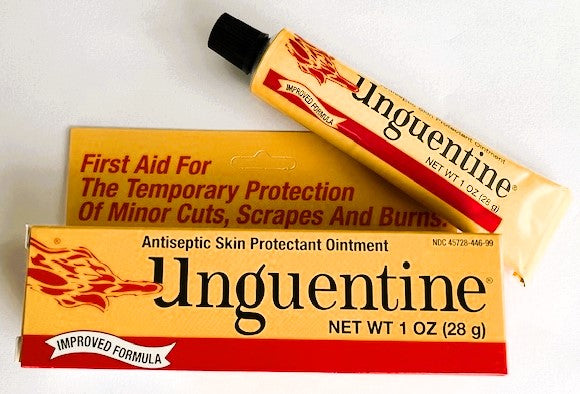
Unguentine Antiseptic Ointment, 1 oz

Swipe to see all 2 photos
Product Details
Unguentine Antiseptic Ointment is an over-the-counter first aid ointment for the temporary protection of minor cuts, scrapes, and burns. The current Oakhurst Company label (NDC 45728-446, revised April 2025) lists phenol 1.5% as a first aid antiseptic and zinc oxide 6.6% as a skin protectant, with camphor, lavender oil, and petrolatum as inactive ingredients. It comes in a 1 oz tube and is sold directly by Oakhurst Company of Bethpage, New York.
Unguentine at a glance
|
Detail |
Information |
|---|---|
|
Product |
Unguentine Antiseptic Ointment |
|
Type |
Over-the-counter first aid ointment, topical |
|
Active ingredients |
Phenol 1.5% (first aid antiseptic); zinc oxide 6.6% (skin protectant) |
|
Inactive ingredients |
Camphor, lavender oil, petrolatum |
|
Use (per label) |
First aid for the temporary protection of minor cuts, scrapes, and burns |
|
Directions (per label) |
Clean the affected area; apply a small amount 1 to 3 times daily |
|
Size |
1 oz tube |
|
NDC |
45728-446 |
|
Labeler (FDA DailyMed) |
Oakhurst Company, Bethpage, NY |
|
Label revised |
April 2025 |
|
Price |
$15.00 (3 tubes for $39.00) |
What is Unguentine used for?
Unguentine is labeled for first aid use: the temporary protection of minor cuts, scrapes, and burns. Phenol is the first aid antiseptic and zinc oxide is the skin protectant.
- Minor cuts: first aid protection for small cuts.
- Minor scrapes: first aid protection for superficial scrapes.
- Minor burns: temporary protection for minor burns.
It is not labeled for deep wounds, puncture wounds, animal bites, or serious burns. The label says to ask a doctor before using it on any of these.
Unguentine ingredients
|
Active ingredient |
Strength |
Purpose |
|---|---|---|
|
Phenol |
1.5% |
First aid antiseptic |
|
Zinc oxide |
6.6% |
Skin protectant |
Inactive ingredients: camphor, lavender oil, petrolatum.
Drug Facts
Active ingredients / Purpose
Phenol 1.5% — First aid antiseptic
Zinc oxide 6.6% — Skin protectant
Uses: First aid for the temporary protection of minor cuts, scrapes, and burns.
Warnings: For external use only.
Ask a doctor before use if you have deep or puncture wounds, animal bites, or serious burns.
When using this product: do not get into eyes; do not apply to large areas of the body; do not bandage; do not exceed recommended dosage.
Stop use and ask a doctor if the condition persists or gets worse, or the condition does not improve within 7 days.
Keep out of reach of children. In case of accidental ingestion, seek professional assistance or contact a Poison Control Center immediately.
Directions: Clean affected area. Apply a small amount to the affected area 1 to 3 times daily.
Other information: Keep container closed when not in use. Store at 59°F to 86°F (15° to 30°C).
Inactive ingredients: Camphor, lavender oil, petrolatum.
Questions or comments? 1-800-831-1135 or www.oakhurstco.com
Label text as listed in the FDA DailyMed record for NDC 45728-446 (revised April 2025). The label on your package is the controlling version.
How to use Unguentine
- Clean the affected area.
- Apply a small amount to the affected area.
- Repeat 1 to 3 times daily, as the label directs.
For external use only. Do not bandage. Keep the container closed when not in use and store it at 59°F to 86°F (15° to 30°C).
When a burn or wound needs a doctor
A minor burn can usually be handled with first aid, and the first step is cooling it. Mayo Clinic advises running cool (not ice-cold) water over a minor burn, or using a cool wet cloth, until the pain eases. It also advises emergency care for a burn larger than about 3 inches (8 cm) across and for electrical or major chemical burns. A burn on the eyes, mouth, hands, or genitals, or any burn on a baby or older adult, may need emergency care too. The American Academy of Dermatology also publishes minor-burn care guidance.
If you use Unguentine afterward, follow the Drug Facts directions above. Stop use and ask a doctor if the condition gets worse or does not improve within 7 days.
Who makes Unguentine today?
The current Unguentine Drug Facts label and the FDA DailyMed record for NDC 45728-446 name Oakhurst Company, 428 N. Wantagh Ave., Bethpage, NY 11714, as the labeler. Oakhurst is a family business that was founded by brothers Stanley H. and Alfred Roberts and is led today by the next generations of the family. Read more on the About Oakhurst Company page.
Older encyclopedia and news references describe earlier eras and name other producers, including Norwich Pharmacal Company (the original 1893 maker) and Lee Pharmaceuticals. For the product sold on this page, rely on the current label and DailyMed record.
The history of Unguentine
Unguentine reached the market in 1893, made by Norwich Pharmacal Company of Norwich, New York, the company that later became known for Pepto-Bismol. Local-history reporting describes it as starting out as a surgical dressing supplied to nurses, with its use on burns becoming widely known afterward.
The Smithsonian's National Museum of American History holds Unguentine packaging from several eras, including a 1 oz "Unguentine Ointment, Original Formula" made by Norwich Pharmacal around 1973, and an earlier Unguentine package from about 1920.
Original formula vs. the current label
"Original Formula" is a name Unguentine has carried for decades, and the formulation has changed over time. Some older references and retail listings describe four active ingredients: camphor 3%, phenol 2.5%, tannic acid 2.2%, and zinc oxide 6.6%. The current Oakhurst label lists two actives, phenol 1.5% and zinc oxide 6.6%, with camphor as an inactive ingredient. Rely on the Drug Facts printed on the package you receive rather than on an older description.
Buy Unguentine direct from Oakhurst Company
The 1 oz tube is $15.00, or 3 tubes for $39.00 using the multi-pack option above. Orders ship within 3 business days by FedEx, UPS, or Postal Service, and shipping starts at $10.00 for one item. See Shipping Information and Returns, or call 1-800-831-1135 or 516-731-5380. You can also browse more traditional remedies from Oakhurst Company.
Unguentine FAQ
What is Unguentine Antiseptic Ointment used for?
Unguentine is labeled for first aid: the temporary protection of minor cuts, scrapes, and burns. It is not labeled for deep wounds, puncture wounds, animal bites, or serious burns. The label says to ask a doctor before using it on those.
What are the active ingredients in Unguentine?
The current Oakhurst Company label lists two active ingredients: phenol 1.5%, a first aid antiseptic, and zinc oxide 6.6%, a skin protectant. The inactive ingredients are camphor, lavender oil, and petrolatum.
Does Unguentine contain camphor or tannic acid?
On the current label, camphor is an inactive ingredient and tannic acid is not listed. Some older references and retail listings describe a four-active formula with camphor 3%, phenol 2.5%, tannic acid 2.2%, and zinc oxide 6.6%. Check the Drug Facts on the package you receive.
Is this the original Unguentine formula?
"Original Formula" is a name Unguentine has carried for decades, and the formulation has changed over time. The Smithsonian holds a c. 1973 Norwich Pharmacal package marked Original Formula. Today's Oakhurst label lists phenol 1.5% and zinc oxide 6.6%. Always follow the Drug Facts on your package.
Who makes Unguentine today?
The current Unguentine Drug Facts label and the FDA DailyMed record for NDC 45728-446 name Oakhurst Company of Bethpage, New York. Unguentine was first made in 1893 by Norwich Pharmacal Company, and some older references list other producers, including Lee Pharmaceuticals.
How do you use Unguentine ointment?
Clean the affected area, then apply a small amount to it one to three times daily, as the Drug Facts directions state. Keep the container closed when not in use. It is for external use only.
Can Unguentine be used on burns?
Unguentine is labeled for the temporary protection of minor burns. For a serious burn, ask a doctor before using it. Mayo Clinic advises emergency care for a burn larger than about 3 inches (8 cm) across and for electrical or major chemical burns.
Should I bandage over Unguentine?
No. The Drug Facts warnings say not to bandage when using this product.
How long can I use Unguentine?
Stop use and ask a doctor if the condition persists or gets worse, or if it does not improve within 7 days. Do not exceed the labeled use of one to three applications daily.
Is Unguentine safe for children?
Keep Unguentine out of reach of children. The directions on the current label do not give a separate dose by age, so ask a doctor or pharmacist about use on a child. If it is swallowed, get professional help or contact a Poison Control Center immediately.
How old is Unguentine?
Unguentine reached the market in 1893, made by Norwich Pharmacal Company of Norwich, New York. Local-history reporting says it began as a surgical dressing for nurses before its use on burns became widely known.
Where can I buy Unguentine direct from Oakhurst Company?
Oakhurst Company sells the 1 oz tube for $15.00, or 3 tubes for $39.00, on this page. Orders ship within 3 business days by FedEx, UPS, or Postal Service, with shipping starting at $10.00 for one item.
Sources
- FDA DailyMed: Unguentine (Oakhurst Company), NDC 45728-446
- Mayo Clinic: Burns, first aid
- American Academy of Dermatology: How to treat minor burns
- Smithsonian National Museum of American History: Unguentine Ointment, Original Formula, 1 Oz
- WBNG: 'Here in History': Unguentine, from Norwich to the Hindenburg Disaster
Unguentine is an over-the-counter drug for external use. This page is general information and does not replace advice from a doctor or pharmacist. Always read and follow the label on your package.